History of Culcheth
Bronze Age pottery found in Croft indicates that humans were living in this area about 4000 years ago. The area was then densely wooded, on the edge of a large peat bog, parts of which still survive in Chat Moss and Risley Moss. It is believed that the name 'Culcheth' originated from an old name for 'at the edge of a wood'. There is no mention of the village in the Domesday Book; it was within Warrington, then called Walintune. Culcheth was part of the parish Winwick, which was an important point on a Roman road.
The first mention of Culcheth was in 1212 when it was held by Hugh, son of Gilbert, by 'knight's service' of William le Boteler, Baron of Warrington. William the Conqueror had divided the lands of England among his Barons and these were subdivided by the Barons into smaller manors just large enough to support one knight, who had to perform military service for his overlord. In the 13th Century Warrington was an important market town and river crossing point. It had been a major crossing point on the river Mersey since ancient times and there had been a Roman settlement at Wilderspool.
By 1242 the manor was held by Gilbert de Culcheth. He was killed in 1246 by unknown villains, and the township was fined because it made no pursuit. He left four infant daughters: Margery, Elizabeth, Ellen, and Joan, who became wards of the Lord of Warrington. As they became older, William le Boteler granted their marriage to Hugh de Hindley. Hugh married them to his own four sons, and Culcheth was divided among them. Its four quarters became the manors of Richard, who took the name of de Culcheth; Adam, called de Peasfurlong; Robert, called de Risley; and Thomas, called de Holcroft. Culcheth is in the north; Holcroft and Peasfurlong, the eastern and western parts of the centre; and Risley in the south. The boundaries are not always clearly defined but the eastern and northern boundaries are formed by the Glazebrook and its tributary the Carr Brook; another brook on the west divides Peasfurlong from Croft, with the southern boundary drawn through moss land. The deeds record that in compensation for the 'waste and desert' character of much of Risley, Robert and Ellen received Gilbert de Culcheth's lands in Lowton.
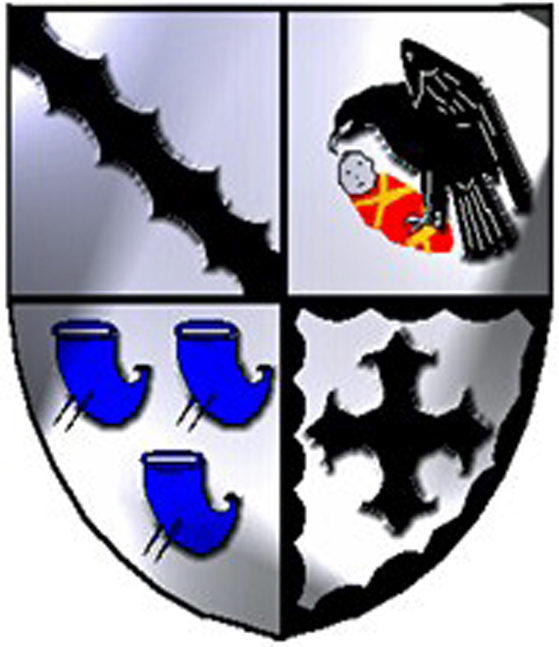
For the next 500 years there were numerous inter-marriages between the original four families, along with disputes over faith, land and property. During the English civil war the Holcrofts were Parliamentarians while the Catholic Culcheths supported the Royalists. The Culcheth coat of arms was changed to reflect marriages between families and incorporates each family’s coat of arms, clockwise from top left: Peasfurlong , Culcheth, Holcroft, Risley,
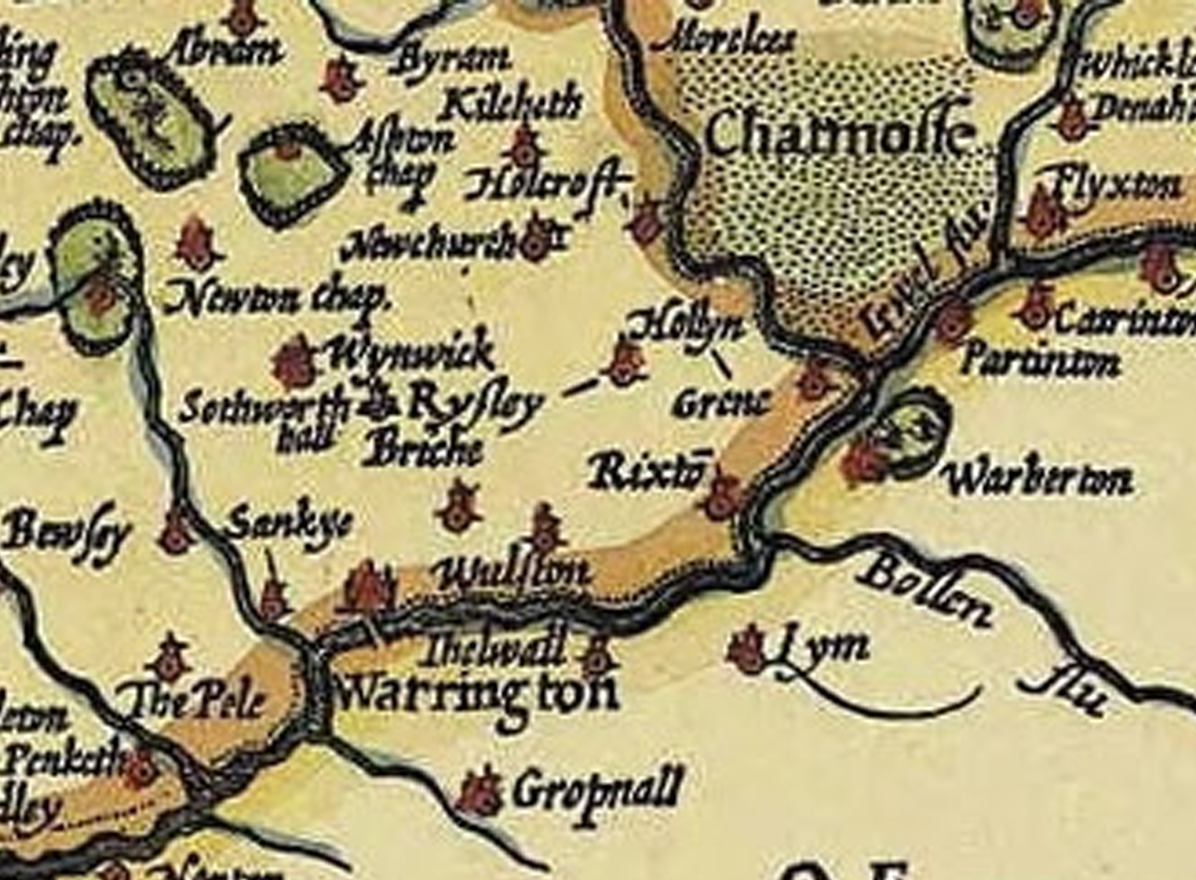
This 17th Century map shows the area of modern Culcheth, then recorded as Kilcheth, with Holcroft and Newchurch and nearby Risley. The name 'Newchurch', part of modern Culcheth, refers to the building of the village's first church about 1538, as it was a new church, separate from the main parish church in Winwick.
The demise of the 'Culcheth' family came with the death of Thomas Culcheth in 1747 without a male heir. In accordance with his Will, the manor passed to his cousin Thomas Stanley of Eccleston. On the death of his daughter, in 1794, the manor went to John Trafford, who had married Catherine Culcheth. Trafford died in 1815 and about eight years later the manor and lands were sold to Peter Withington, who then became the local 'lord of the manor' and occupied Culcheth Hall.
In the 18th century a Culcheth Township Committee was formed, with 5 men from each of the manors of Culcheth, Holcroft, Peasfurlong and Risley. They met for more than a century from 1716 to 1818. They dealt with land enclosure and common land, road maintenance, help for the poor, school maintenance, etc.
At the beginning of the 19th century it became customary for estate owners to assume control of local affairs in place of elected village committees. The powerful people in Culcheth were the lord of the manor Peter Withington, and then his descendants all called Thomas Ellames Withington, and the church warden. A trustworthy and strong villager was chosen to act as village constable.
In the late Victorian era it was decided that local government should be more democratic and so elect councils. Culcheth was placed in Leigh Rural District in 1890 and had a parish council consisting of Newchurch, Risley and Glazebury wards. When the Leigh Rural District was abolished In 1933 Culcheth became part of Golborne Urban district. At the next local government reorganisation Golborne was too big for a parish council so there was a successful campaign to have the urban district divided and Culcheth & Glazebury was joined to Warrington instead of Wigan.
The basic layout of the village has not changed much from that shown on 18th century maps, with the main roads of today following the route of the roads from 250 years ago. The Village Green, previously used as common land for hundreds of years, was eventually given in perpetuity to the children of the village in exchange for permission to build shops fronting the main road.