Culcheth Cottage Homes
Did you know that the grand houses of Stonyhurst Crescent used to be home for poor children from Salford? Workhouses for poor people had existed for hundreds of years, generally providing awful living conditions. Towards the end of the 19th century conditions gradually improved and in particular it was recognised that children should be housed away from the workhouse. The Salford Poor Law Union decided to build a model children's home in the countryside in Culcheth. This 'cottage home' was completed in 1903, located around what is now Stonyhurst Crescent and is shown on this map from 1928
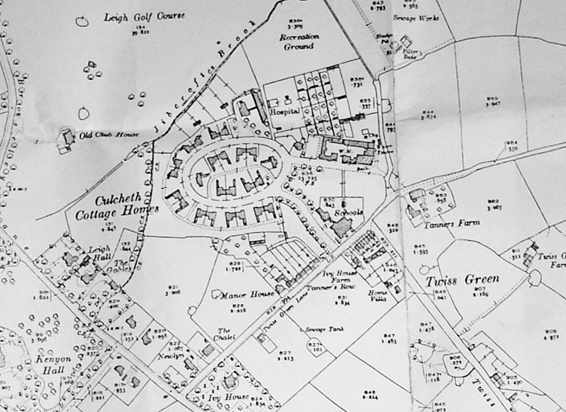
Pauper children and orphans were housed in groups of about 14 in each house under the supervision of a house-mother or a house-father. In addition to large houses the home included a school, an infirmary, a swimming bath, several workshops, farm land and recreation areas.
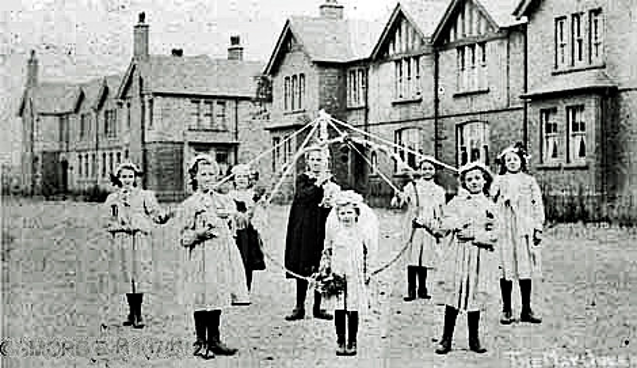
The children would attend school until the age of 14 and attend workshops to teach them skills that would enable them to get a job. Workshops for boys included Joinery, Plumbing, Shoemaking, Glazing & Painting. They were put to use doing maintenance around the property. There was also an Engineers workshop which provided electricity and heat for the colony. Girls were taught mainly domestic duties and expected to gain employment as servants, spinning, shop assistants or possibly nursing if they were able. Both boys and girls were taught gardening and produced much of the food required by the colony. There was a Bakehouse to produce their own bread, etc. All staff and children were expected to attend church every Sunday. This photo shows Maypole Dancing by a group of girls at Culcheth Cottage Homes.
The Cottage Homes closed in 1936 and after the war became Newchurch Hospital providing care for people with mental health conditions. The hospital closed in 1991 and in 1995 the buildings were refurbished and converted into residential properties. It is now a designated Conservation Area.
This is an extract from the personal memories of Cyril Ormandy, born in 1920, who was taken to the Cottage Homes as a baby:
I was placed first in the nursery and then at about 18 months old moved into a house with eleven older boys aged 3 - 14 in the care of our home 'mother'. She was strict but kind and looked after us very well. There were two bedrooms with six beds in each room. The toilet was outside but we had a chamber pot in the middle of the room. Boys lived in the outer circle of houses and girls in the inner circle. Boys weren't allowed to even talk to girls and there was no talking at all in the school classroom.
There was a strict routine in the house. We got up at 6.30am and had breakfast, usually porridge, at 7am. We all had jobs to do like lighting the fire, washing up, changing sheets, mopping floors and then off to school at 9am. School started with assembly and prayers and then we were taught reading, writing and arithmetic. We would rush home for lunch, usually soup, then back for afternoon school. Swimming was part of the curriculum using the swimming pool provided. Each Sunday we walked in a long crocodile to the service at the Parish Church and in the afternoon we usually had another long walk up Broseley Lane, through Croft and back along Mustard Lane.
The Superintendent’s wife looked after clothing, rations and general welfare including dental care, immunisation, and coping with children's infectious diseases such as measles, chicken pox, mumps and whooping cough. When two of us got diphtheria we were put in a tent in the back field for two weeks isolation so we couldn't pass the infection to others. A doctor made regular visits to the Homes and would perform operations on the kitchen table to remove children's tonsils when necessary.
We had a piggery and one of the storerooms was looked after by a Butcher who would butcher the pigs for distribution of meat to the houses. There was also a bakery that produced seven pound loaves for house rations. A horse was used to pull the rope hoist to lift big bags of flour to the upper floor of the bakery. A Shoemaker's shop was kept busy making and repairing shoes for all boys and girls. There was an electrician's workshop that had a generator supplying the whole site with DC electricity. Small electric shock were quite common in all the buildings. The generator was driven by steam from the Boiler Room, which also pumped water from a well up to the high tower (still standing) for distributing throughout the houses and provided heating for the swimming pool and a busy laundry.
The Carpenter's shop taught woodwork and also did general repairs around the Homes. We made some of the school desks and a large raft when we were taken on a camping holiday to Heswall on the Wirral. The Home's Painter and Decorator was also the Scout Master. I was also in the Homes boys band, playing the trombone.
The auditorium in the hall was used for a variety of public functions. Each New Years Eve there was a dance for local villagers. The Newchurch Orchestra held concerts there and the local Horticultural Society held shows there. We had weekly silent film shows and these were open to the public for a few pence.
I enjoyed my time at Cottage Homes and didn't want to leave but I knew that I would have to when I reached 14. Some boys were lucky to get apprenticeships in the various trades that kept the Homes going but a few days after my birthday I was sent to work on a farm in Staffordshire. I was instructed not to write to my house mother for at least six months so that there was a clean break.