Colonel Blood
What is the link between Culcheth and the only, nearly successful, theft of the Crown Jewels from the Tower of London? Well, the mastermind of the heist was the famous Colonel Blood who was married to Mary Holcroft from Culcheth. She was the daughter of local gentry, John Holcroft of Holcroft Hall (a listed building in our parish). Colonel Blood sounds like the name of a fictional character but he was certainly real. He was famous in his own lifetime so there are contemporary reports, books have been written about him and there are historic documents in the National Archives. Not only did he steal the Crown Jewels but after being caught and imprisoned in the Tower he managed to persuade the King to pardon him and was even rewarded. After his death years later he was so well known as such a tricky character that his body was dug up again to check that he really was dead. If you want to know a bit more detail read on.
Thomas Blood was born in Ireland in 1618 to a wealthy family of English descent. His father was described as a Blacksmith or Ironmaster but he owned land in Meath and Wicklow and his grandfather lived in a castle and was an MP. As a young man Thomas spent time in Lancashire and it was here that he met and married Mary Holcroft from Culcheth. He was certainly in the army and he liked to be known as the Colonel but he may not have had that rank; he was known as both Captain Blood and Colonel Blood during his lifetime. When the English Civil War broke out in 1642 Thomas initially fought on the side of the Royalists but when he saw that the other side were likely to win he switched sides and joined Cromwell's army of Roundheads. It is thought that he acted as a spy in the civil war and when it was over he was well rewarded by Cromwell with lands in Ireland. However, when the Monarchy was restored in 1660 those lands were taken back from him and he went looking for revenge.
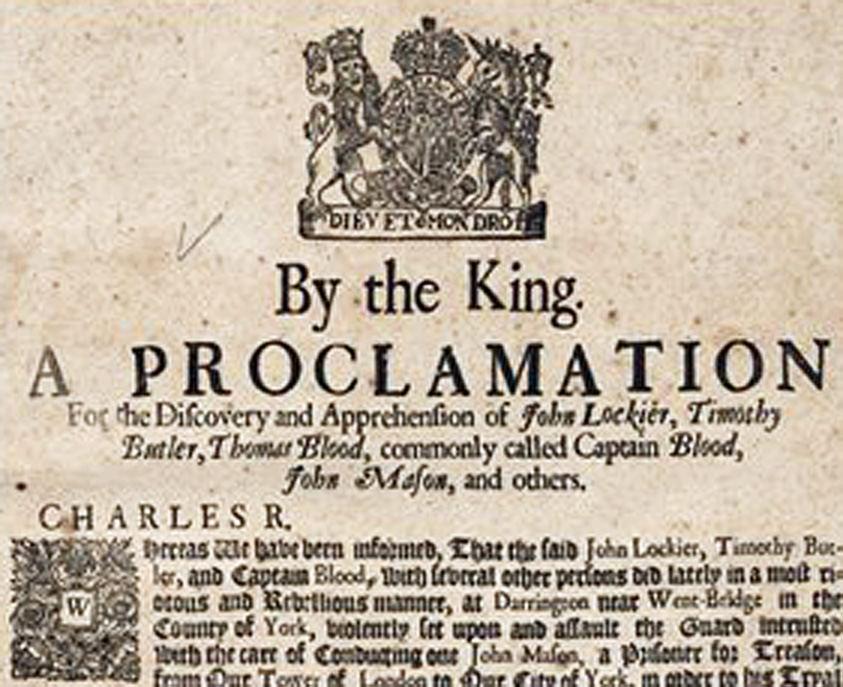
He got involved in a number of adventures and it seems that he was part of various groups opposed to the government but also involved in government counsels. It is likely that he was a 'double-agent'. In 1660 he tried to capture the Duke of Ormond, who was Lord Lieutenant of Ireland at Dublin Castle. Using disguise he and his co-conspirators tried to enter the castle but they were discovered and most were arrested. Thomas managed to escape to Holland by using various disguises. In 1667 he tried to rescue his friend Captain Mason from a government escort on their way to York. He succeeded in the rescue but Thomas was wounded and several troopers were killed. In 1670 he tried again to capture the Duke of Ormond while he was visiting England. Again he failed but again he was able to escape.
His most famous adventure was stealing the Crown Jewels: the jewelled crown, sceptre and orb. The Keeper of the jewels was an old ex-soldier, Talbot Edwards, who lived in the Tower with his wife and family. To supplement his wages Talbot was allowed to show the jewels to visitors for a fee. Blood disguised himself as a Parson and went to see the jewels with a woman he introduced as his wife. His actual wife, Mary Holcroft, was at her family home at this time. During the visit the woman pretended to have a sudden stomach upset and kind Talbot took them to his private apartment to recover. A few days later the 'Parson' returned with a gift of gloves to thank Mrs Edwards for her kindness. On a subsequent visit Blood mentioned that he had noticed that Edwards had a daughter eligible for marriage and that she may like to meet his wealthy nephew. By arrangement, on the 9 May 1671 Blood turned up with his 'nephew' (actually his own son) and two other men he introduced as friends. He said that his wife would join them soon and while they were waiting perhaps they could see the jewels.
When they reached the jewel room poor Talbot was set upon and when he cried out for help he was hit with a wooden mallet and stabbed in the stomach. The thieves tried to hide the orb and sceptre in their clothes and Blood crushed the crown flat to hide it under his cloak. Fortunately, Talbot's son who happened to be home unexpectedly after several years away, heard his father's cries and raised the alarm for the guards. Talbot survived and the thieves were captured during their escape and imprisoned in the Tower. As an act of treason they could expect to be executed.
Blood refused to speak to anyone but the King and several petitions were sent from Blood, his son and his wife Mary. No one is sure how he managed it but Blood got to see the King and persuaded him to grant a pardon. Furthermore, he was given a pension and had his Irish lands returned to him. It is thought that the King was generous to Blood for previous unknown service or perhaps the King thought that killing Blood would have stirred up too much trouble with his various associates and he could be more useful to him alive than dead.
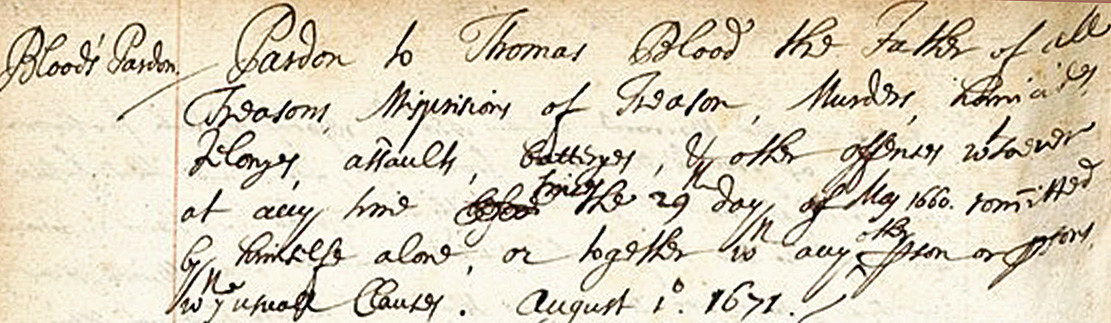
Transcript: Pardon to Thomas Blood the Father of all Treasons, Misprisions of Treason, Murders, homicides, Felonyes, assaults, batteryes, & other offences whatsoever at any time since the 29th day of May 1660 committed by himselfe alone, or together with any other person or persons with the usuall Clauses. August 1st 1671
Colonel Blood lived on comfortably for several years and was often seen at the royal court but few people trusted him. In 1680 he fell out with the Duke of Buckingham and was sued for defamation of character for the massive sum of £10,000. Before he could answer for it Blood had a stroke and died. Due to his notoriety as a rogue and trickster his body was exhumed several weeks after death to check that he was really dead.